


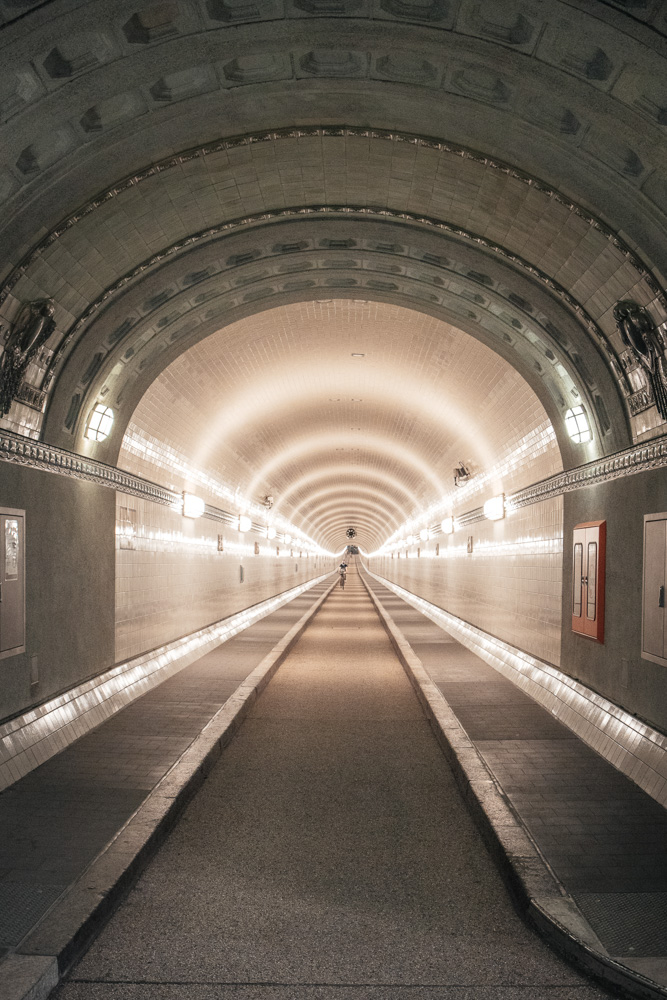
The Old Elbe Tunnel is one of Hamburg's most impressive structures – and simultaneously one of its most underrated. While tourists take photos at the Landungsbrücken piers, cyclists and pedestrians pass right by their feet through a tunnel under the Elbe River that is over 100 years old. Anyone who has experienced it once will never forget it.
Here are the 10 most important facts about the Old Elbe Tunnel – from its history to practical tips for your visit.
The Old Elbe Tunnel (officially: St. Pauli Elbe Tunnel) was opened on September 7, 1911 It was opened. This makes it over 110 years old, and it still functions today as a pedestrian and bicycle tunnel. It was planned and built during a time when Hamburg was booming as a global port, and workers from the residential areas north of the Elbe had to commute daily to the shipyards and docks on the south side.
The tunnel was not only a technical marvel at the time, but also a socio-political project: Previously, dockworkers had to use ferries, which often failed to open in winter and cost money. The Elbe Tunnel was free for pedestrians and cyclists – and remains so to this day.
The most impressive figure: The tunnel lies at its lowest point 24 meters below the surface of the Elbe River. The total length is 426.5 meters. For comparison: That's roughly four times the length of a football field.
The tunnel was built using the cut-and-cover method – the Elbe River was pumped dry, the tunnel was embedded in the riverbed, and then the riverbed was flooded again. This technique was considered a masterpiece of engineering for its time.
The Old Elbe Tunnel was, at its opening, the world's first underwater tunnel built exclusively for pedestrians and bicycles. Other tunnels of this period – such as the Thames Tunnel in London – were railway tunnels. A purely passenger tunnel of this depth and length was unique in 1911.
What's special about it: From the very beginning, it had elevators – also state-of-the-art technology at the time. These faithful replicas of the original freight elevators still exist today, and they are also used for bicycles.
The construction was a direct result of the Hamburg port boom. Thousands of workers commuted daily between the residential areas on the north side of the Elbe and the shipyards, docks, and warehouses on the south side. The ferries were slow, expensive, and prone to breakdowns.
Therefore, the Hamburg Senate initiated the tunnel construction. At its opening, up to [number missing] people used it. 12,000 people daily – predominantly workers with wheelbarrows, handcarts and bicycles. Today it is mainly tourists and Hamburg residents who want to experience the tunnel's special charm.
The tunnel consists of two parallel tubes, which are connected by cross passages. Each tube has its own elevator and staircase. The tubes are each approximately 6 meters wide – sufficient for two lanes of traffic plus pedestrians.
Current notice: One of the two tunnels has been undergoing extensive renovations for several years and is therefore closed to visitors. Operations continue via the second tunnel – opening times and current information can be found directly on the Hamburg Port Authority (HPA) website, which operates the tunnel.
The Old Elbe Tunnel was severely damaged during the bombing of Hamburg in July 1943 ("Operation Gomorrah"). Water flooded the tunnels, and parts of the interior were destroyed. Nevertheless, it was restored and reopened after the war.
This is also one reason why the current interior is not completely original – nevertheless, great emphasis was placed on preserving its historical character during the restoration.
In the year The Old Elbe Tunnel was placed under monument protection in 2003.. This means that every renovation measure must preserve the historical fabric. The characteristic white tiles, the cast-iron stairs, the wooden benches, and the yellow lighting – all of which give the tunnel its distinctive atmosphere – are particularly protected.
The ongoing renovation of the second tube is correspondingly complex and expensive: every detail must be restored as faithfully to the original as possible.
The tunnel is no longer a secret: Round one million people They visit the Old Elbe Tunnel every year. This makes it one of Hamburg's most visited sights – even though it is still listed as an "insider tip" in many travel guides.
It is particularly popular with cyclists who use it as a connection between the Landungsbrücken (St. Pauli Piers) and the southern bank of the Elbe. From the south side, there is one of the most beautiful views of the Hamburg skyline and the Landungsbrücken.
What makes the tunnel so unforgettable is the overall experience: the smell of damp brickwork, the slight echo of footsteps, the yellow lighting, the white tiles, and the quiet rustling that reminds you that you are directly under the Elbe River.
Inside the tunnel, there are also colorful tile mosaics on the walls depicting historical motifs – including scenes from the Port of Hamburg and sea creatures. These mosaics are little known, but absolutely worth seeing.
It is free to use. For both pedestrians and cyclists. That was the case from the beginning and remains so to this day – a relic from the original idea of providing dockworkers with a free connection.
Motor vehicles were also allowed to use the tunnel in the past (hence the wide tubes), but that has not been the case for years. Today it is reserved exclusively for pedestrians and cyclists.
Address: At the St. Pauli Landungsbrücken, 20359 Hamburg (entrance north side)
Opening hours:
Getting there by public transport: S-Bahn S1/S3 or U-Bahn U3 to Landungsbrücken
The Elbe Tunnel is part of one of Hamburg's most beautiful cycling routes: From the Landungsbrücken through the tunnel to the south side, along the Elbe riverbank towards Övelgönne and on to Blankenese – a route with breathtaking views of the Port of Hamburg and the Elbe.
A rental bike from Happy Bikes is perfect for this tour. We're within walking distance of the main train station and rent out road bikes, gravel bikes, e-bikes, and city bikes – including a free helmet, lock, and phone holder, with no booking fees.
Rent a bike now and explore the Elbe Tunnel on your own →
Or you can book one of our guided bicycle tours, where we drive through the Elbe Tunnel – for example the tour “The best of Hamburg”, which leads directly through the tunnel.
The Old Elbe Tunnel in Hamburg is 426.5 meters long.
The tunnel lies at its lowest point 24 meters below the surface of the Elbe River.
The Old Elbe Tunnel was opened on September 7, 1911.
Yes, the use of the Old Elbe Tunnel is free for pedestrians and cyclists.
Yes, bicycles are allowed in the tunnel. However, you must push your bicycle – riding in the tunnel is not permitted. There are special elevators for bicycles.
The tunnel is open to pedestrians 24 hours a day. The bicycle lifts have limited operating hours (Mon-Fri approx. 5:30 am - 9:00 pm). As renovation work is currently underway, it is recommended to check the current operating hours with the Hamburg Port Authority.
Schultzweg 7
20097 Hamburg
We already have over 1,100 genuine reviews from enthusiastic customers on Google. 5/5 stars speak volumes, and we'll continue to do everything we can to ensure that doesn't change! Experience our 5* service for yourself now!
We provide helmets, locks, and cell phone holders free of charge.

You are currently viewing a placeholder content from TrustIndex. To access the actual content, click the button below. Please note that doing so will share data with third-party providers.
More Information